
Mode breakdown
A hybrid mic that solves a real setup problem
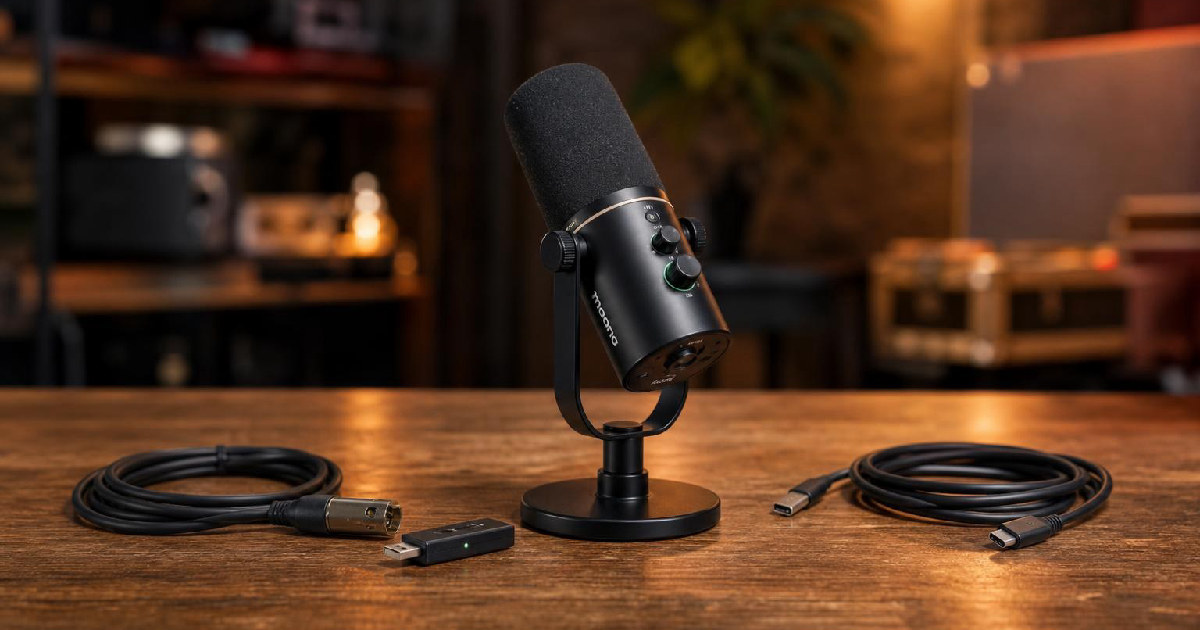
Tom Buck’s review of the Maono PD200W starts with the feature that makes the mic worth talking about at all: it is not just a dynamic broadcast-style microphone. It is also wireless, and it can work over USB and XLR. That combination is the core of the video and the reason the mic stands out in a crowded budget category.
Buck’s practical point is simple. If you are trying to record two USB microphones on the same computer, or if you want a microphone that can keep going even when a cable is disconnected, the PD200W is designed to make that easier. The wireless receiver lets both mics behave like a single input for recording, which avoids some of the usual friction that comes with multi-mic USB setups. For people who want a straightforward way to run two voices without leaning on a more complicated software workaround, that is the headline.
He is also careful about the target audience. This is not a microphone for a large broadcast studio or a high-end podcast room built around expensive interfaces and mixers. It is for people who need decent audio, want flexibility, and do not want to spend a lot of money or time assembling a more technical chain.
What the wireless and multi-output design actually changes
The PD200W’s unusual value is not just that it has wireless. Buck emphasizes that it can send the same microphone to several places at once. In the video, he routes audio over XLR into a RØDECaster Pro 2, over wireless USB into Adobe Audition on a MacBook Pro, and over wired USB into OBS on a PC at the same time. That is not a common requirement, but it shows why the microphone feels more versatile than a typical budget dynamic.
This flexibility also creates a useful backup path. If one recording chain fails, another can still be running. Buck frames that as one of the strongest reasons to pay attention to the mic: redundancy is valuable, especially for creators who are recording interviews, streams, or simple podcast sessions and want an extra layer of insurance without adding a separate recorder.
The wireless design does come with limits. Buck says the mic behaves as one single source when used wirelessly, so if you are expecting two separate tracks for two speakers, that is not how it works. Monitoring also matters. He notes that monitoring the wireless signal can introduce noticeable latency, which makes it awkward to hear your own voice delayed in the headphones. His advice is practical: monitor the mic you are actually using, and if there are two people, each person should monitor their own microphone rather than sharing a delayed feed.
That framing keeps the review grounded. The PD200W is not trying to mimic a traditional studio workflow. It is trying to simplify a few common ones.
What the app helps with, and where it stops helping
A lot of cheaper microphones are basically one-note devices: plug in, maybe change gain, and that is it. Buck points out that Maono’s app gives the PD200W more personality. In Maono Link, he can switch between presets like original, podcast, and gaming, then build a custom profile with EQ adjustments, high-pass and low-pass options, reverb, compression, and a limiter.
That part of the video matters because it shows the mic is not just about hardware gimmicks. The software can shape the sound enough for users who want a little more polish without needing to understand a full studio chain. Buck does not present the app as a substitute for proper editing, though. He is skeptical of the built-in noise reduction, especially at heavier settings. In his test with a noisy background, the reduction made the sound less natural and less pleasant to listen to for any length of time.
His judgment is specific: if you are recording and can edit later, you will probably get better results from software tools in post rather than baking aggressive noise suppression into the recording. If you are streaming live or working in a situation where editing is not an option, a light touch may be acceptable. But the built-in system is a compromise, not a miracle fix.
Another useful detail: the app-based processing does not affect the XLR output. That means if you use the microphone over XLR, you are getting the dry signal. USB and wireless get the digital processing, but XLR stays separate. For some users that is a drawback; for others it is exactly what they want.
How it sounds against familiar alternatives
Buck does not treat the PD200W like a solo product. He compares it with several microphones people already know: the Fifine AM8, Rode PodMic USB, Shure MV7+, Rode Interview Pro, Rode NT1 Signature, Shure SM7B, and DJI Mic Mini. The comparison set is important because it places the Maono in a real buying context.
Against the Fifine AM8, the PD200W feels like the more flexible choice, even though both sit in the budget conversation. Against the Rode PodMic USB and Shure MV7+, the Maono has a price advantage, but those microphones offer stronger build quality and, in some cases, cleaner handling behavior. Buck repeatedly points out that the PD200W is more prone to handling noise, which is why the included shock mount matters.
That tradeoff shows up again with the SM7B. The Shure is more expensive, much more gain-hungry, and far less convenient for casual setups, but it is also more forgiving in build and handling. Buck’s larger point is not that the PD200W sounds identical to more established microphones. It is that the Maono gets surprisingly far for the money, especially if your priority is easy use and flexible routing rather than a classic studio chain.
The Rode Interview Pro comparison is interesting for another reason: it highlights how much the wireless microphone market has shifted toward simple, receiver-based workflows. The PD200W borrows some of that convenience and packages it in a broadcast-style body. The DJI Mic Mini comparison reinforces the same idea from another angle. A small, simple wireless system and a larger microphone body may look unrelated, but in practice they are solving the same basic problem: get audio into a single receiver without complexity.
Who the PD200W is actually for
The cleanest way to understand Buck’s conclusion is to ask what the PD200W is not trying to be. It is not trying to be the best-sounding microphone in a cost-no-object studio. It is not trying to replace the SM7B in a pro room. It is not trying to outbuild the Rode PodMic USB. What it is trying to do is much more practical: give ordinary creators a microphone that can work in more than one mode, sound decent, and fit a low-friction workflow.
That matters for people who are starting a podcast, recording voice tracks at home, doing a two-person setup, or just want a microphone that can move between devices without a lot of extra gear. Buck’s review suggests the PD200W succeeds most when you think of it as a flexible tool first and a sound-quality contest entry second.
The limitations are real. Wireless recording is one track, not separate isolated tracks. Monitoring can be awkward over the wireless feed. The noise reduction is better left light or avoided. The mic can pick up handling noise. But none of those weaknesses cancel out the bigger value proposition, which is that this thing can do a lot of different jobs for a relatively low cost.
For readers deciding whether it belongs in their setup, that is the main takeaway: the Maono PD200W is worth attention because it reduces friction. If you need a mic that can be wireless, USB, and XLR without asking you to build a more complicated system around it, Buck’s test shows why it feels unusual in a good way.
Recommended next
Products & tools
One Mode Digital Media product and one relevant affiliate recommendation selected for this page.

Ctrl + Alt + Escape Reality
A surreal keyboard design built around the ultimate digital shortcut: “Ctrl + Alt + Escape Reality.” A glowing portal turns the Escape key into a way out for gamers, tech fans, creators, dreamers, and anyone ready to leave the ordinary screen behind.
Flippa
A marketplace for buying and selling websites, apps and other digital businesses.