
Mode breakdown
Canva’s real AI role is the handoff, not the headline model
Ronnie Hermosa’s central argument is straightforward: Canva is not trying to beat ChatGPT, Claude, or Gemini at generating the first draft. It is trying to own the moment when a draft stops being a rough output and starts becoming something a creator or business can actually use.
That is the most useful way to read the video. Hermosa, who frames the discussion around Canva’s AI direction, shows a workflow that begins in a large language model and ends in Canva. The value is not in the draft alone. It is in the handoff. Canva is positioned as the place where the image, copy, layout, and branding become editable, shareable, and ready to publish.
For creators, that distinction is practical. A generated image may look promising, but if the logo is wrong, the font is off, the colors do not match the brand, or the layout needs to change for another platform, the output is still incomplete. Canva’s pitch is that it sits exactly where the work gets stuck.
Why a flat draft is not enough for real work
Hermosa demonstrates the limit of a standard AI-first design workflow by starting with a simple prompt in ChatGPT for a luxury resort Instagram ad. The result is visually decent and close to the right format, but it is still a flat output. It can be a starting point, but not the finished asset.
That gap is the whole reason Canva matters in this video. Once the image comes back from the model, Hermosa shows how connecting ChatGPT to Canva changes the next step. Instead of treating the result like a dead-end PNG, he turns it into an editable Canva design. From there, the creator can change colors, swap icons, adjust the background, refine the message, apply brand elements, and resize the design for different formats.
This is where the workflow becomes more realistic for actual publishing. Hermosa keeps returning to the same practical issue: creators do not usually need an AI image for its own sake. They need a usable asset. That means the output has to survive brand review, team feedback, platform resizing, and whatever comes next in the publication process.
The video also makes a useful point about the difference between generation and production. AI tools can often generate a draft quickly, but production involves all the unglamorous work that makes the draft fit a real campaign. Canva’s role is to absorb that part of the workflow.
The partnership strategy that keeps Canva inside the workflow
Hermosa’s second big point is that Canva is not picking a side in the AI model race. It is partnering broadly. In the video, he points to Canva integrations or connections with ChatGPT, Claude, Gemini, Perplexity, and HeyGen as evidence that the company is meeting users where they already work.
That strategy makes sense in the way Hermosa explains it. If people are already researching, prompting, and drafting inside other AI tools, Canva does not need to pull them away at the beginning. It only needs to show up at the point where the draft becomes hard to finish elsewhere.
This is a strong distribution play. Rather than asking users to choose Canva first, Canva becomes the place they arrive at after the model has done its job. Hermosa describes that as Canva owning the middle and end of the workflow: branding, editing, collaboration, resizing, translation, and publishing. In other words, Canva is trying to become the production layer that sits between AI generation and final output.
The argument here is less about technology and more about positioning. Foundation models are competing to be the brain of the workflow. Canva is trying to be the workshop where the work gets finished. That is a different kind of advantage, and one that can work across multiple model providers instead of depending on only one.
Canva’s moat is built on editability, collaboration, and templates
Hermosa also explains why this strategy may be hard for model makers to copy quickly. Even if OpenAI, Anthropic, or Google could build a Canva-like interface, they would still have to recreate the layers Canva has spent years assembling: brand kits, templates, collaboration tools, approvals, comments, asset management, and a large ecosystem of creator-made designs.
That matters because the strongest part of Canva is not simply that it can make things look good. It is that it organizes design work for teams and brands. Hermosa emphasizes the brand kit workflow, the ability to collaborate with others, the approval process, and the availability of millions of templates. Those are not flashy features, but they are the ones that turn a draft into something publishable inside a real organization.
He also notes Canva’s large user base as part of the advantage. The platform already has people inside it who understand it as a design environment, not just an AI toy. That gives Canva a built-in path for introducing AI without asking users to abandon the way they already work.
The creator takeaway is clear. If your workflow depends on consistency, revisions, and multiple versions of the same asset, the quality of the first AI output is only part of the story. Editability is the part that decides whether the work gets used.
What creators should take from this shift
The most practical lesson in the video is not that Canva will beat every model company. It is that creators should rethink where AI fits in their process.
Hermosa’s version of the workflow starts with research, moves into prompting a model for a first draft, then passes that draft into Canva for refinement and publishing. That sequence is useful because it separates the job of generating ideas from the job of shipping a finished piece.
For creators, that has a few implications:
Start by asking what still needs human control
If a design needs brand alignment, format changes, or team approval, then a raw AI draft is not the end of the process. It is the beginning.
Use AI for speed, not finality
Hermosa’s demo shows why first drafts are useful even when they are imperfect. The point is to get to something tangible faster, then improve it in a tool built for editing.
Think in systems, not one-off outputs
Canva’s value grows when a creator needs multiple versions of the same idea: different sizes, different languages, different platforms, or different team members reviewing the work. That is where Canva’s workflow advantage becomes visible.
Watch the middle of the workflow
The biggest strategic shift in the video is not that AI can now generate more things. It is that the middle layer — the place where work gets branded, approved, and published — may be where the real platform advantage lives.
Hermosa ends with a broader prediction: the next stage could be even tighter integration between model and editor, where creators call AI tools from inside Canva itself. Whether that exact future arrives or not, the larger point stands. Canva’s AI story is not about replacing the model. It is about making the model’s output usable.
Recommended next
Products & tools
One Mode Digital Media product and one relevant affiliate recommendation selected for this page.
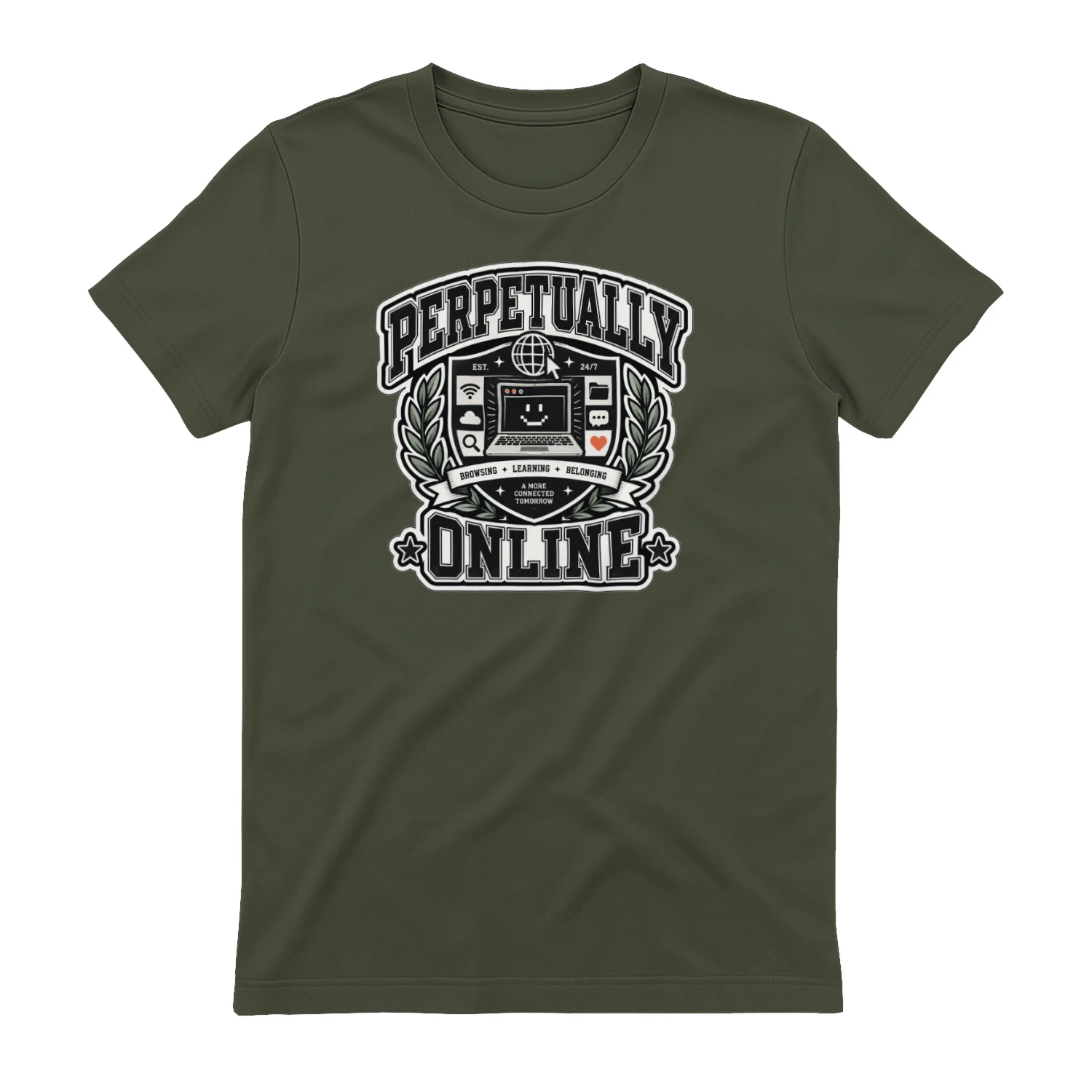
Perpetually Online
A collegiate-style internet culture design for people who practically live on the web. “Perpetually Online” turns constant connectivity into a tongue-in-cheek badge of honor for creators, gamers, streamers, social-media regulars, and professional tab keepers.
Artlist
Music, footage and creative assets for video-first creators.