

Mode breakdown
Why copying competitors is a weak creative starting point
Dara Denney opens with a blunt argument that will sound familiar to anyone who has spent time inside Meta Ads Manager: if you are relying on competitor ads because you are unsure what will convert, the real problem is confidence, not just inspiration. Her case is not that competitive research is useless. It is that copying whatever is already in market leaves too much strategy to chance. You may be borrowing something that works for someone else’s offer, audience, or positioning without understanding why it works at all.
That is the practical value of this video. Denney is not presenting a magic formula for getting “winning ads.” She is offering a way to think more clearly about why an ad works, how to spot the core idea inside it, and how to turn that learning into a repeatable creative system. For founders, media buyers, and creative strategists, that shift matters because Meta creative often fails for a simple reason: teams keep making ads at volume before they know what they are actually trying to repeat.
The three principles behind the workflow
Denney frames the rest of the video around three basics: the big idea, pattern recognition, and prioritization. Together, they act like a filter for creative decisions.
The big idea
The first principle is the “big idea,” a classic advertising concept she credits to David Ogilvy. In her telling, every strong ad has a core concept or essence that makes it worth repeating. That does not mean every ad needs to be a giant campaign theme. It means someone on the team should be able to state what the ad is really about in a sentence or two.
That is useful because a lot of ad review gets stuck at the surface level. Teams describe format before meaning: “it’s a UGC video,” “it’s a static,” “it’s a founder ad.” Denney pushes the opposite order. First identify the idea, then decide the format.
Pattern recognition
The second principle is pattern recognition. Denney’s point is straightforward: if you can spot what keeps showing up across top performers, you can make better decisions about what to duplicate, remix, or retire. She describes this as noticing recurring personas, messaging angles, visuals, and creative structures inside an account or niche.
For Meta ads, that is a more useful habit than endlessly chasing novelty. Pattern recognition helps a team see that a specific type of promise, setting, or voice is carrying performance across multiple ads. Once you can name the pattern, you can build around it instead of guessing at it.
Prioritization
The third principle is prioritization, and Denney treats it as a real strategic constraint, not just a project-management detail. If one idea is fast to test as a static and another requires a larger shoot, creator coordination, or animation work, those are not equal options. She wants teams to ask which idea can be validated quickest and which one has the strongest evidence to scale.
That tradeoff is especially helpful because creative teams often confuse effort with potential. A more complex concept is not automatically a better one. Denney’s logic is to test the easiest version that can prove the idea, then invest more once the signal is there.
Framework one: mine your ad account for the next winner
Denney’s first framework is the most concrete one: your next strong creative probably already exists somewhere in your ad account. Not as a finished duplicate, but as a recurring idea waiting to be recast.
Her suggestion is to look at top performers over a meaningful period, extract the big ideas behind them, and ask how those ideas could travel into another format. A winning video may become a static. A creator-led ad may become a founder-led version. A proof point buried in the voiceover may become the headline of a new test.
The value here is not just reusing assets. It is reusing insight. Denney gives the example of an ad where the original surface format looked like a casual “get ready with me” style piece, but the actual hook was the promise of doing the routine in five minutes. Once the team identified that, the next version was built around the time-saving idea rather than the format itself.
That is the kind of translation Meta advertisers often need. The visual packaging may change, but the winning logic stays intact. Denney also argues that once a big idea works in one format, it should be pushed into others as part of a wider creative ecosystem. In her view, scale comes from showing the same core learning in multiple versions, not from treating each ad like an isolated experiment.
What a creative ecosystem really means
Denney uses the phrase “creative ecosystem” to describe a set of ads that supports one another rather than competing as random one-offs. That means a strong idea can show up in video, static, creator content, and partnership ads while still feeling fresh enough to keep testing.
This is one of the more useful parts of her argument because it reframes creative diversity. Diversity is not just about making ads look different. It is about expressing the same persuasive idea in ways that reach different people or reinforce the message across multiple touchpoints.
For teams managing Meta budgets, that perspective can reduce the pressure to invent from scratch every week. If the learning is strong, the task becomes expansion, not reinvention.
Framework two: use viral organic content when account data is thin
The second framework is designed for a different stage of the problem. If an account does not yet have enough historical data, Denney says to look at viral TikTok and Reels content for clues about what is currently resonating.
Her method is not to copy the content outright. Instead, she looks for repeated patterns in smaller accounts that are gaining traction: the same phrasing, the same visuals, the same type of creator, or the same sort of setting. When those patterns repeat across different posts, she treats them as signals that the angle may be worth testing in paid creative.
She also uses this process to look for personas the brand may not be targeting well yet. That is a sharp distinction. The point is not only to find a new hook. It is to identify a customer segment, reviewer type, or champion user that existing ads may be missing.
Denney suggests this approach can help both smaller and larger brands. For newer accounts, it provides a way to generate hypotheses without waiting for months of ad history. For larger accounts, it can reveal new audience angles that the current creative system has not fully explored.
How to choose which ideas deserve a test
By the end of the video, Denney has a simple answer to the “what now?” problem: prioritize ideas based on how quickly they can produce useful data and how much evidence suggests they can scale.
That means a static may deserve priority if it can validate an idea fast. A creator-led or partnership-ad concept may deserve more weight if the evidence suggests it has stronger long-term performance potential. She also admits there is still room for judgment here. Not every decision can be reduced to a spreadsheet. Gut matters, but it works best when it is informed by prior patterns.
For creative strategists, that may be the most actionable takeaway in the whole video. The goal is not to produce more ads for the sake of volume. It is to create a shorter path from idea to proof.
What this framework changes for Meta teams
Denney’s model is useful because it moves Meta creative away from guesswork and toward interpretation. Instead of asking, “What should we make next?” teams can ask:
- What is the big idea behind our best work?
- Which pattern keeps repeating across winners?
- What is the fastest way to validate the next version?
- If we do not have enough data, which organic signals look worth testing?
- Which audience gap might our current ads be missing?
That is not a flashy process, but it is a durable one. It gives teams a way to make creative decisions with more confidence, especially when performance pressure makes it tempting to chase whatever seems to be working elsewhere.
For readers who build, buy, or brief Meta ads, Denney’s video is worth keeping close because it treats creative as a system of evidence, not a stream of guesses.
Recommended next
Products & tools
One Mode Digital Media product and one relevant affiliate recommendation selected for this page.
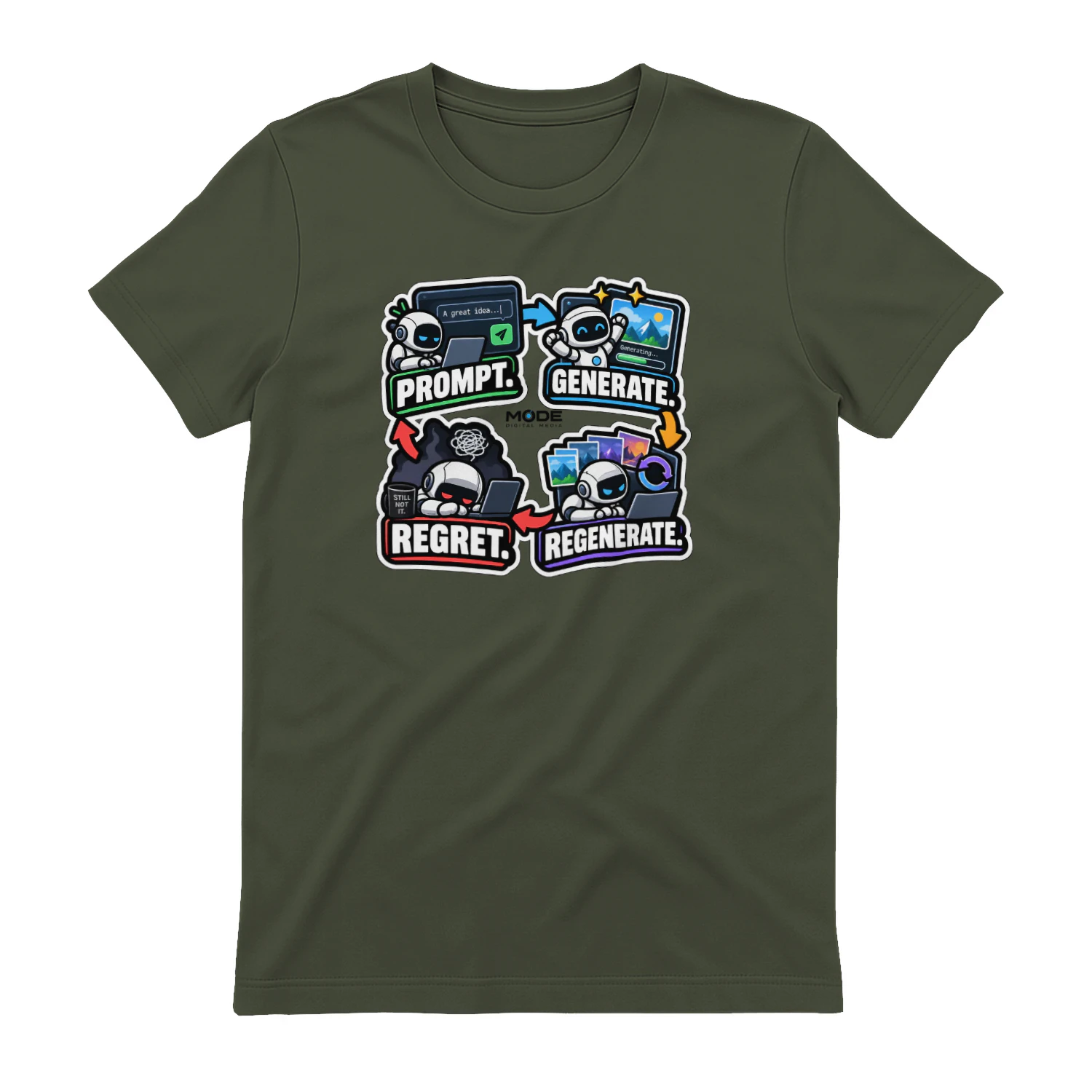
Prompt. Generate. Regenerate. Regret.
A painfully accurate four-step creative workflow for the generative-AI age: “Prompt. Generate. Regenerate. Regret.” Built for designers, writers, creators, prompt tinkerers, and anyone who has watched one simple idea turn into twenty-seven versions.
Envato Elements
Templates, graphics, video, audio and design assets in one subscription.