
Mode breakdown
The problem with calling this a GoPro
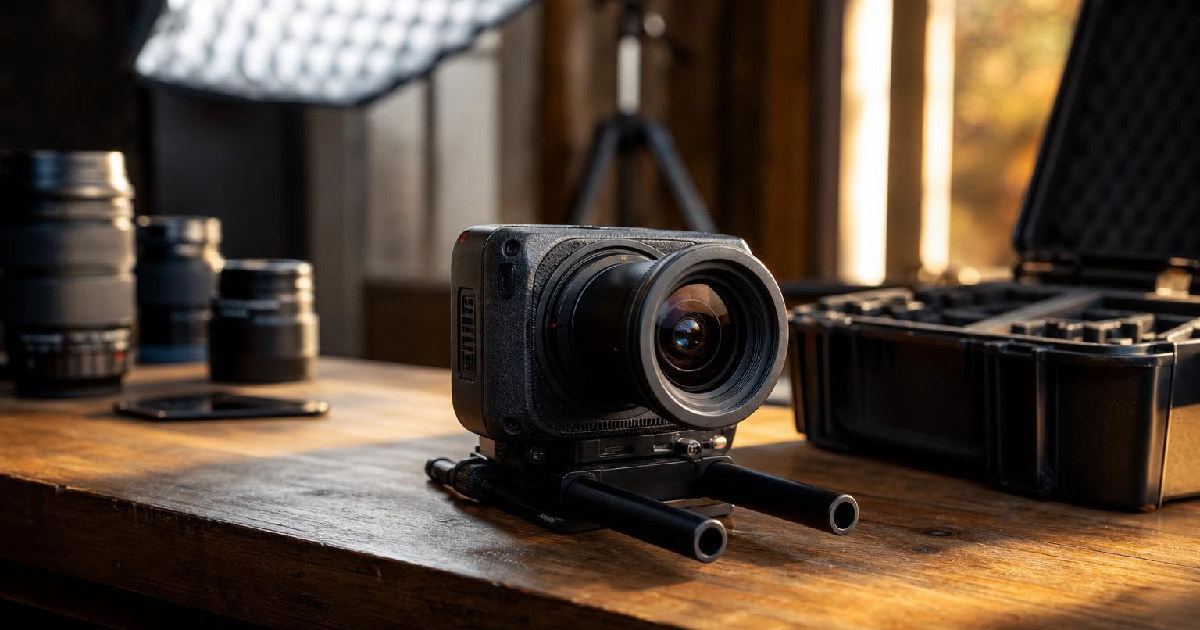
Tom Buck’s main point is simple: the new GoPro with interchangeable lenses is being judged against the wrong category. That is why so much of the conversation around it feels off. If you approach it like a standard Hero-style camera, the manual focus, lens mount, and missing all-in-one convenience can look like drawbacks stacked on top of one another. If you approach it as a compact cinema camera, those same choices start to make sense.
Buck has used GoPros for more than 15 years, so he is not arguing from novelty. He has also seen the company’s usual action-camera identity from every angle: small, durable, mountable, and easy to point at the scene. That is the familiar promise. His argument is that the Mission ILS breaks that pattern in a meaningful way. The interchangeable lens system changes the camera’s relationship to the world around it. You are no longer just choosing where to mount it; you are also choosing how to see through it.
That distinction matters because it changes what the camera is for. Buck is blunt that he does not care whether viewers buy it. What he does care about is whether they understand it. In his view, the biggest mistake GoPro made was presenting it with familiar action-camera imagery, which invites the wrong expectations. A camera that can be mounted to a car and still requires manual focus is not solving the same problem as a traditional GoPro.
A tiny cinema camera changes the rules
Once Buck reframes the camera as a small cinema tool, the whole product starts to look more interesting. He describes it as a secondary camera for productions that already have a main cinema camera. In that role, size becomes an advantage instead of a compromise. It can fit into tight spaces, serve as a crash camera, or capture angles that would be awkward for larger gear.
That is also why he sees value in the lens mount itself. A fixed-lens action camera almost always looks like an action camera in the final edit, even when it does the job well. But a camera that accepts cinema lenses can be shaped to match the style of the project. Buck mentions using a 6 mm Micro Four Thirds cinema lens and wanting to try a 35 mm lens next, which suggests the real appeal is flexibility rather than a single signature look.
He also notes that the camera is still durable in the body, even if the lens makes it less rugged than a sealed all-in-one action cam. That is the practical tradeoff: the body can still feel GoPro-like, but the lens introduces the kind of vulnerability you expect from a more traditional camera system. Dirt can get into the mount. A fall can damage the lens. The camera stops being the thing you throw anywhere without thinking.
For Buck, that is not a flaw so much as a signal. This is a camera that asks you to work differently.
Why the camera makes sense for students and new creators
Buck’s strongest argument is educational. He spent 11 years as a high school digital media teacher, and that experience gives the video its clearest real-world stakes. He is not imagining a luxury setup; he is imagining a classroom where students need to learn fundamentals, handle gear repeatedly, and work within a limited budget.
From that perspective, the camera has two appealing traits. First, it is compact enough to be used often. Second, it forces the user to learn the same concepts that show up in larger production workflows. There is no autofocus safety net to lean on. Students have to understand focus, lens choice, aperture, and the relationship between them. Buck specifically points to focus peaking as one of the camera’s best teaching tools because it is easier to read than the versions found on many cameras. The display changes color depending on the scene, which helps keep the in-focus areas visible even when the subject and the overlay might otherwise blend together.
That matters because learning camera work is often less about memorizing settings and more about building habits. Buck’s argument is that a camera like this can become an extension of a student’s process. If it is always with them, they are more likely to internalize the workflow. He contrasts that with the kind of camera that is excellent in capable hands but too forgiving to teach the fundamentals by necessity.
He also gives the obvious budget comparison: if a program or a beginner is choosing between a handful of these and fewer more expensive mirrorless or cinema bodies, the cheaper route may let more people learn more often. He is not saying the GoPro replaces a Sony or a Canon cinema setup. He is saying it can sit underneath that level of gear in a way that still teaches the same language.
The practical tradeoffs: durability, focus, and lens choice
The camera’s appeal comes with clear limits, and Buck does not hide them. Manual focus is one of the biggest friction points for anyone expecting a normal action camera experience. But that is exactly why he keeps repeating that the product should not be judged by action-camera standards. A manual-focus camera is a problem only if you think the camera’s job is to behave like the older GoPro format.
The lens choice is another tradeoff. Buck’s 6 mm lens is wide, useful for some shots, but not the only option he would want. He is already thinking about how a different focal length could change the camera’s look. That is a valuable clue for anyone weighing the system: the body alone does not define the result. The lens is part of the creative decision, which means the camera rewards people who want control and can absorb a little extra complexity.
There is also the question of fit. Buck compares the total cost, once lens and body are together, to entry-level interchangeable-lens cameras and cheaper Canon bodies. That comparison is not meant to say they are interchangeable in every way. It is meant to highlight a real tradeoff: you are paying for a very specific set of strengths rather than a broad general-purpose camera.
For creators who want a durable, tiny camera that can live inside a larger production, that specificity is the point. For people who want the usual action-camera ease, it is probably the wrong tool.
Why context matters more than first impressions
Buck’s video is less a review than a correction. He wants viewers to stop asking why GoPro would make a manual-focus action camera and start asking what kind of production problem the company is trying to solve. Once the camera is viewed through that lens, its oddities become features with a purpose.
That is also why he brings in Markiplier’s perspective. He points to another creator who has made feature work and sees the camera as a tool that could change how he approaches filmmaking. Buck’s use of that example is not about celebrity endorsement; it is about seeing the camera from the standpoint of someone who already understands how secondary cameras fit into a broader project.
His final position is measured. This is not a camera for everybody, and it should not be sold as if it were. But in the specific lane of tiny cinema cameras, classroom tools, and supporting angles for bigger productions, it offers something that was not really available in this exact form before.
If the launch conversation felt confusing, that may be because the camera itself was framed too close to the old GoPro category. Buck’s answer is to widen the frame.
Recommended next
Products & tools
One Mode Digital Media product and one relevant affiliate recommendation selected for this page.

Online Is Not a Location
A clean, slightly philosophical digital-life design built around a simple reminder: “Online Is Not a Location.” With map-inspired details and nowhere coordinates, it’s for anyone trying to remember that the internet is a place we visit, not the whole world.
Artlist
Music, footage and creative assets for video-first creators.